
The Internet Has Roads. You Just Can’t See Them.
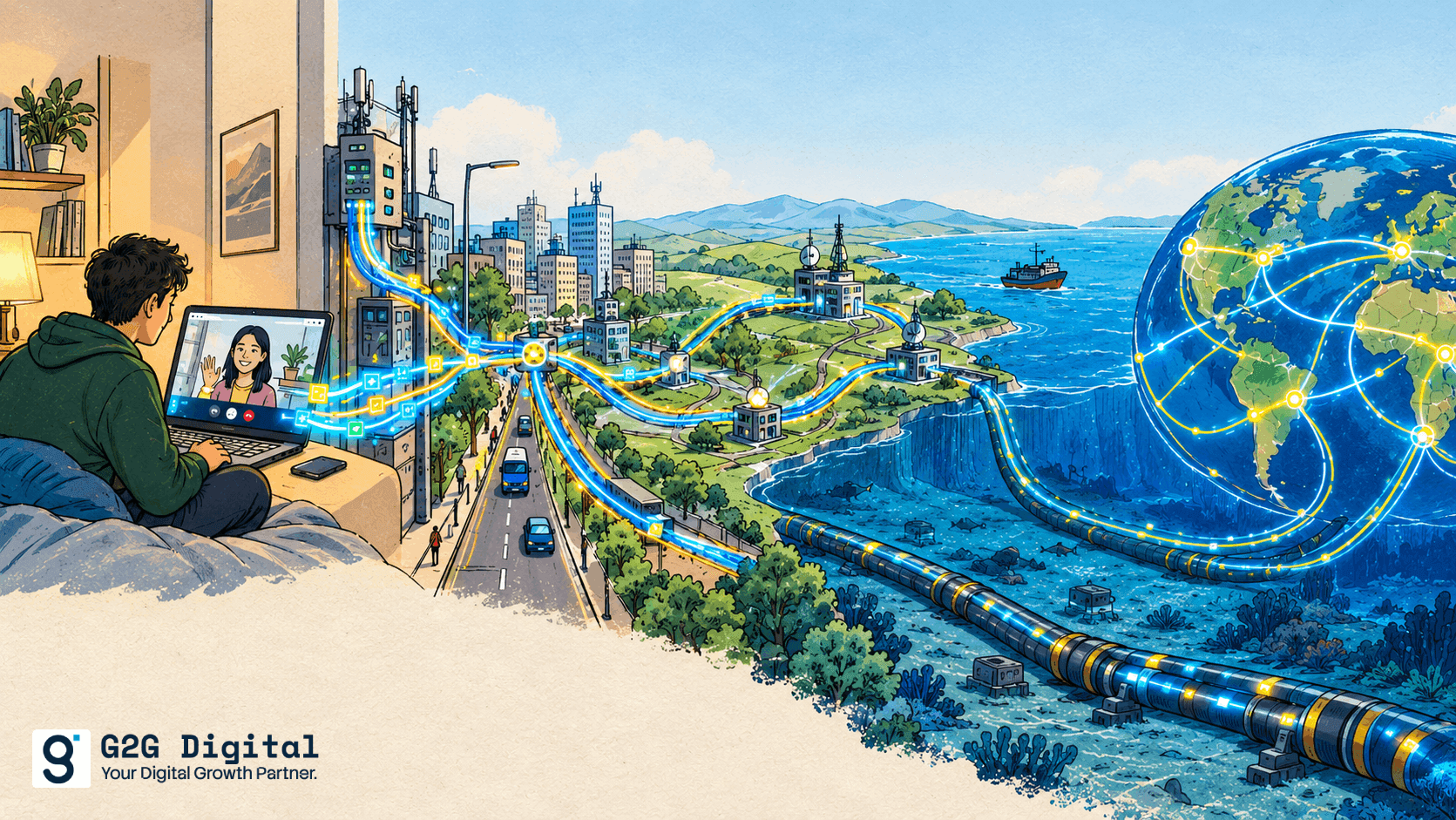
The Moment Something Travels Across the World
Imagine You’re on a video call with someone in another country.
Their face appears on your screen instantly. You speak, they answer, and the conversation feels close — as if the distance between you has simply disappeared. A Both way real time communication through internet.
You hang up, put the phone down, and move on.
The connection just worked, the way it always does.
The Story We Tell Ourselves About Movement
Most of us imagine a simple flow of what just happened.
We imagine the conversation somehow flying through the air, or floating in the same vague “cloud” space we already know about.
The speed makes the journey feel instant and direct — like nothing had to travel at all. It’s just there.
That story is simple and convincing.
It matches the experience: the call felt immediate, so the path must have been simple. For everyday life, the picture is enough.
Yet the whole picture of the flow is incomplete.
The Question that Speed Hides
Let’s Go back to the moment when the other person’s face first appeared.
Something had to cross the distance between you. It did so fast in a fraction of a second, and so cleanly that the movement itself became invisible and vague. It feels like nothing happened.
A quiet question sits underneath that speed:
If the information did not simply float, how did it actually travel and reached here?
We almost never ask it. The result arrives so quickly that the journey feels unnecessary to think about. The call just worked, and that is usually enough.
But the question remains.
The Internet Is a Transportation System
The internet is not only physical storage and computers.
It is also a big transportation system — a network of physical roads that carry information from one place to another.
Your voice, the video of your face, a photo, a message, a webpage — all of them move along these roads. Some roads are short. Some stretch across cities, countries, and oceans. The information does not float or appear magically. It travels.
Once you see the internet this way, the speed stops feeling magical and starts feeling like very good logistics.
The Roads You Can Almost See
Some of the roads are closer than we think.
Cables run around city streets, along highways, and through buildings. They connect neighborhoods, data centers, and local networks. In many places they share the same routes as power lines or cable tracks — quiet, buried, or strung overhead.
You walk past them every day without noticing.
Yet every time you send a message across town or open a local website, part of the journey happens on these nearby roads.
They are the first layer of the transportation system: ordinary, physical, and mostly hidden in plain sight.
The Roads That Cross Oceans
Other roads are far larger. The submarine cable.
Thick cables lie on the ocean floor, stretching between continents. They carry enormous amounts of information under the water — conversations, videos, financial data, and the everyday visitors of the global internet.
These undersea cables are the long-haul highways of the digital world.
When you speak to someone on another continent, part of the conversation almost certainly travels along one of them. The distance is real. The road is physical. The speed is the result of careful engineering, not magic.
The Traffic Lights and Junctions
Information does not travel in a straight line without stops.
Along the way it passes through junctions — places where roads meet, where traffic is directed, and where decisions are made about the best path forward.
Some junctions are small.
Others are large exchange points where many roads connect. At each one, the information is briefly handled and sent onward. The process is fast, automatic, and almost always invisible.
These junctions keep the system organized.
Without them, the roads would quickly become chaotic.
Who Owns and Maintains These Roads?
The roads do not belong to everyone equally.
Some are built and maintained by large companies. Others are operated by specialized network providers. Governments and consortiums also play roles, especially with the long undersea cables.
Maintenance is constant.
Cables get damaged, equipment ages, traffic patterns change. Teams monitor the roads, repair breaks, and expand capacity when needed. The smooth experience you feel depends on this ongoing, mostly unseen work.
The transportation system is shared, but it is not ownerless.
When a Road Breaks or Gets Crowded
Because the internet runs on real roads, real problems can affect it.
A cable can be cut by a ship’s anchor or by construction work. A major junction can become overloaded. A storm or power issue near a key point can slow traffic across a whole region. When that happens, video calls freeze, pages load slowly, or services become temporarily unreachable.
Most of the time the system finds another route.
But the dependence is clear: when a road is blocked or crowded, the digital journey feels it.
Behind every loading screen there might be a crowded road slowing down the traffic.

Seeing the Network Under Every Digital Action
Once you notice the roads, they appear under almost everything.
- Sending a message.
- Streaming a film.
- Joining a video call.
- Loading a map.
- Backing up a photo.
Each of these actions is also a journey.
Information leaves one place, travels along physical paths, passes through junctions, and arrives somewhere else — often in a fraction of a second. The roads are always there, quietly carrying the traffic of daily digital life.
What Changes Once You Notice the Roads
Before, a slow connection or a dropped call usually felt like random failure — “the internet is being weird again.” We justify it with some vague idea like “ The server is down.”
Now the feeling is different.
When something lags, a quieter thought tends to appear: Somewhere along the road, traffic is having trouble.
You rarely need the exact details.
Simply remembering that information travels on real paths makes the delay less mysterious. It becomes a transportation problem rather than pure magic that suddenly stopped working.
That small shift is enough.
Expert in digital growth and web technologies.
View all articles by Joy Chandra Uday

